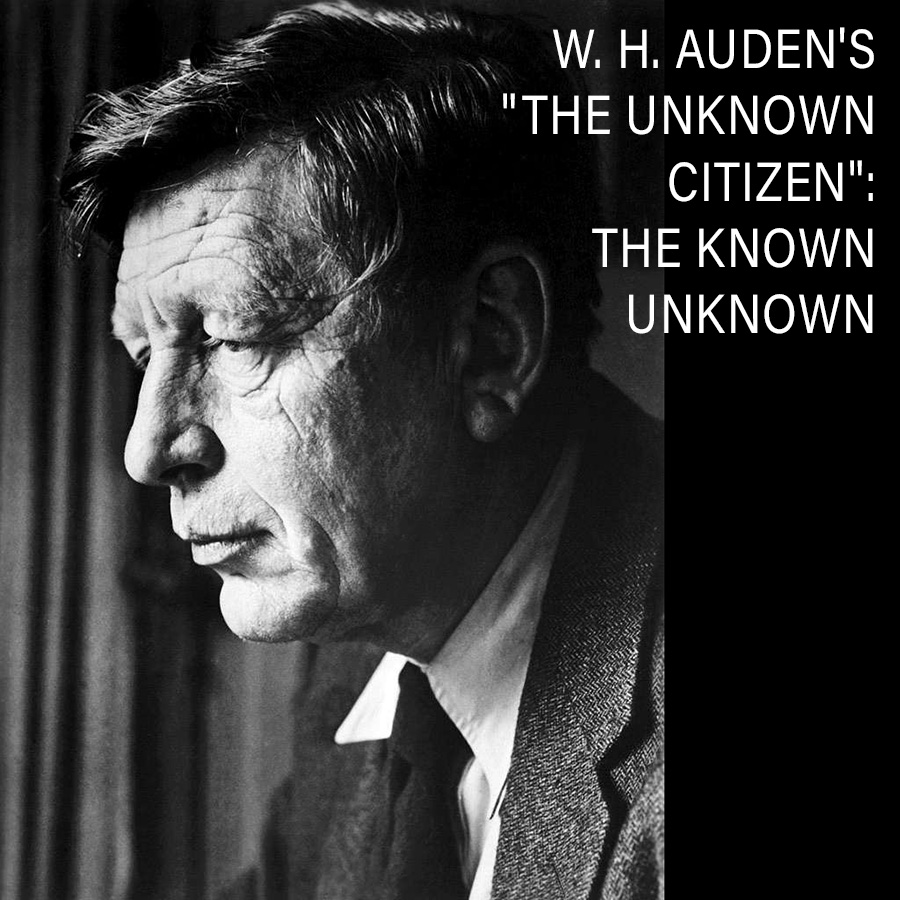
The poem's title explains that the man in question is "unknown", to the capitalist state described and to, ultimately, the reader. Yet the text elaborates on many, if not all, of the things that are, in fact, "known" about him: we are told that "he was a saint"; that he "satisfied his employers"; that "he was popular with his mates and liked to drink"; and so on. His state being unknown is thus implied to be twofold: he has no name; he lives within this capitalist ideology so completely without incident, that there is no reason to "know" him. "Had anything been wrong, we should certainly have heard." The text thus implies that any such wrongness on this man's part would have made him known, while at the same time ironically calls our attention to the fact that there is certainly something "wrong" with a life of being so unknown for this reason. This is the surface contradiction of the work, the paradox that is most apparent.
The text only deconstructs itself if we peer closer at the known/unknown binary. Again, to reiterate, the title suggest the man's unknown-ness. This is set off by the first line of the poem: "He was found by the Bureau of Statistics…." Within the title and the first line we are thus told that the man is both "unknown" and "found"; the remainder of the text elaborates on exactly how the man is, in a sense, known, how he has been "found" to be the "modern man". At once the subject of the text is both known and unknown; he lacks a proper name, but this is merely one signifier he is missing: the text presents us with approximately twelve words that can be applied to him. He is nothing more than a common individual in the capitalist world, language, and ideologies of the text; but he is known to be so. The binary collapses when it is realized that to be known that one is unknown, one must be known of; that is, an unknown thing is not known to be unknown until it is known. The irony at the close of the poem hence deconstructs itself well: the man is free, for he has no other way of being free than to be known, through, language, to be free; were he not known, he would neither be subject to being perceived as free or trapped.
Concluding, the ideological structures of language in the text present a binary of the known/unknown. The apparent ironic gesture of closure at the close of the poem (where the man seems anything but free and unknown) is both an illusion and a site of deconstruction. The ultimate contradiction lies in the man's state of being both known and unknown, free and trapped, by language. While this contradiction appears irresolvable, both sides are necessary relations to the other.